Noise cancellation for your brain.

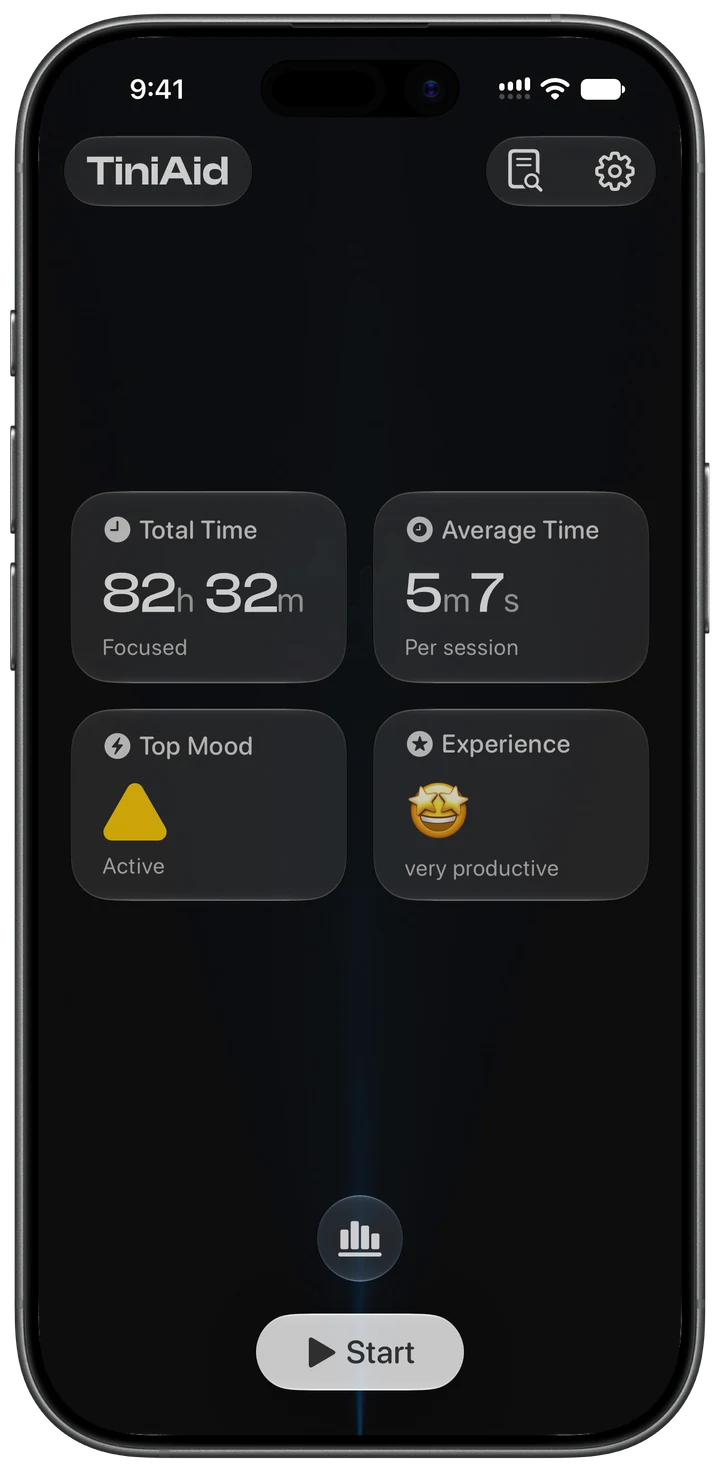
A beautiful ADHD/Autism focus app for iPhone built on deep research into sound and attention. It uses steady rhythms, textures, and layered sound to give your brain something to settle into.


Music engineered for focus and stimulation.
Techno music inspired soundscapes composed and designed to help focus stimming and regulate mental noise.
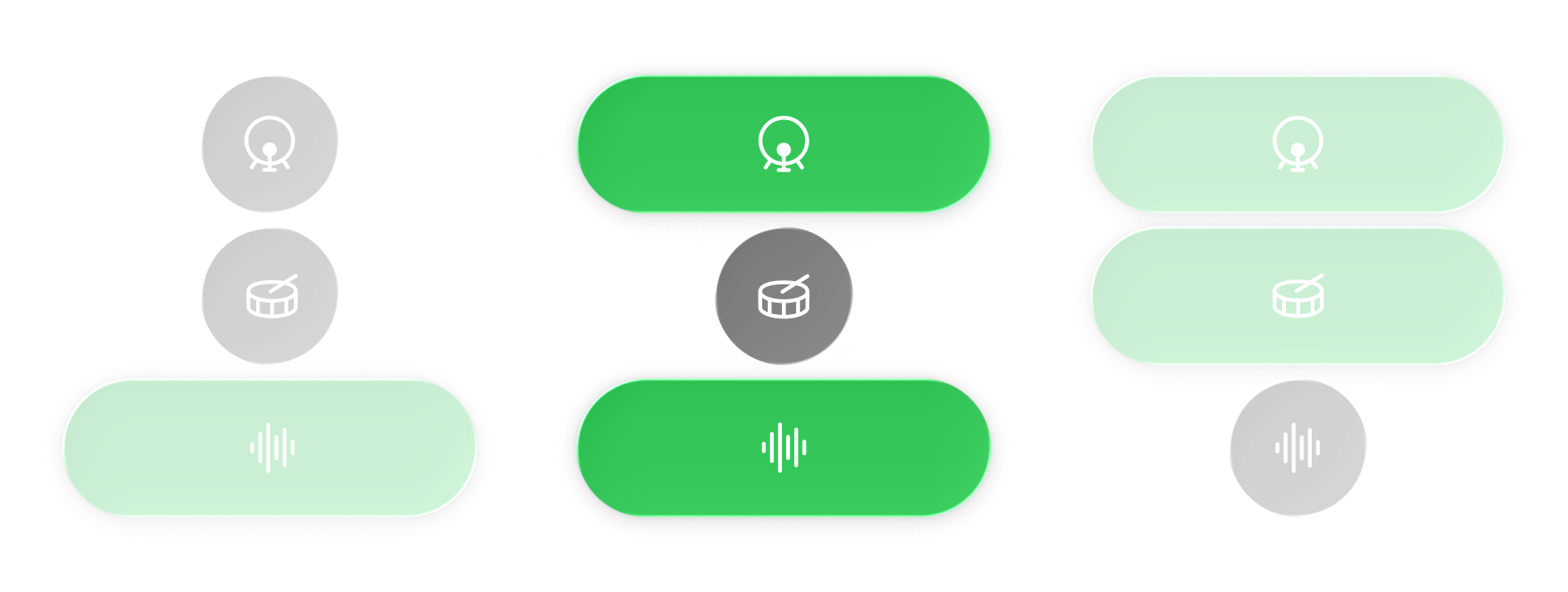
Layer your sound, tune your environment
Mix and adjust sounds to create the perfect environment you need.
Made through research on ADHD
Built on published research papers and studies alongside people with ADHD, gathering valuable insights that directly shaped TiniAid.

Made for iPhone and iPads
Productivity Insights and Siri AI integration
Track your focus habits and uncover daily productivity patterns to know yourself better. Plus, seamlessly control your focus sessions hands-free with Siri AI in iOS 27.
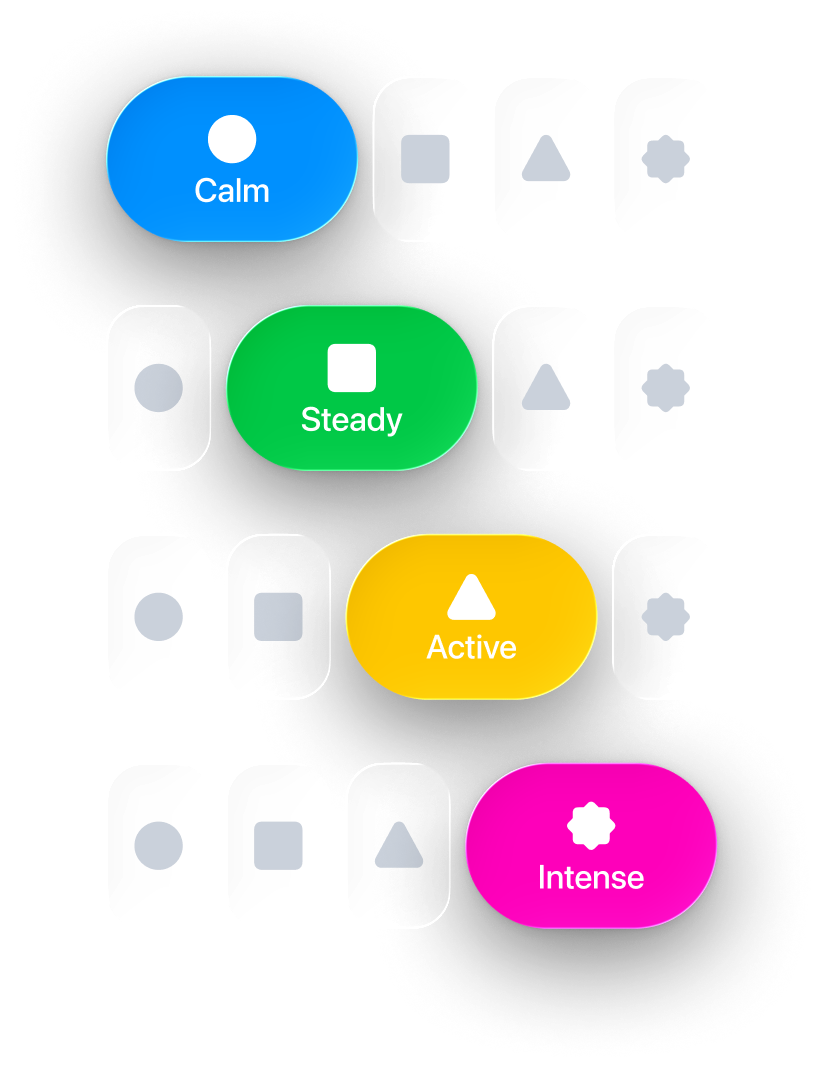
Choose the mood that matches your energy
Calm, Steady, Active, or Intense. Pick the energy that meets you in the moment, and let the sound guide you to the mood you want to reach.

“I built this app for myself,
to help with my ADHD”
and I am confident it will help you too!
Additional Highlights
Apple Health & iCloud
Sync mindful focus minutes to Apple Health and seamlessly back up progress with iCloud.

Dolby Atmos Sounds
Spatial Audio powered by Dolby Atmos for an immersive listening experience, available with TiniAid Plus.
Privacy Transparency
No ads and no tracking. We only collect anonymous interaction data that can never be linked to you.
Supported by Research


Focus apps fail neurodivergent minds
Researchers at UBC and NYU found that rigid timers and app blockers trigger rejection sensitivity and break organic flow in ADHD adults. Instead of punitive limits, predictable auditory media allowed attention to settle without executive strain.

Rapid modulation in music supports attention
Researchers in Communications Biology demonstrated that rapid amplitude modulation in music directly recruits attention networks. Listeners with elevated ADHD symptoms derived significant focus gains from specific beta-range acoustic modulations.

Beat synchronization trains executive control
A randomized trial in Frontiers showed an eight-week beat synchronization program improved inhibitory control, cognitive flexibility, and motor coordination in ADHD children, confirming auditory rhythm coordinates executive circuits.
Auditory rhythm accelerates visual focus
Nature researchers discovered that background auditory beats significantly accelerate visual search speed and reduce error rates during complex tasks, even though the visual tasks themselves contained no rhythmic timing.
Structured beats outperform standard playlists
A systematic review in Frontiers discovered that structured acoustic beats support sustained focus, whereas commercial music with vocal elements and tempo changes triggers constant attentional switching.

ADHD brains fail to filter ambient distractors
Clinical EEG trials in JAACAP showed that while neurotypical children reduce processing of background sounds under heavy visual load, children with ADHD fail to suppress auditory distractors, showing heightened frontal theta coherence.

Atypical habituation demands predictable sound
Harvard researchers in Developmental Cognitive Neuroscience found altered auditory deviance detection and novelty habituation in ADHD cohorts, demonstrating difficulty adapting to unexpected acoustic changes.

Auditory stimulation speeds ADHD alertness
A preregistered trial of 59 children revealed that acoustic stimulation significantly reduced response times on alertness tasks in ADHD subjects, while emphasizing that optimal audio intensity varies individually.

Alpha dynamics reveal fluctuating attention
Researchers in Psychophysiology demonstrated that adults with ADHD show steep declines in pre-stimulus alpha dynamics as time-on-task increases, confirming that attentional endurance fluctuates continuously rather than staying fixed.
Musical structure accelerates stress recovery
A landmark PNAS study proved that the structural dynamics of music, specifically tension and resolution, accelerate autonomic recovery and downregulate stress networks significantly better than passive nature sounds.

Customization must avoid interface fatigue
Accessibility research at ACM ASSETS revealed that while individuals with ADHD require personalized auditory environments, complex configuration menus become their own source of task distraction.

Music therapy acts as complementary support
A clinical perspective in SAGE outlines how music-based approaches support inhibitory control and emotional regulation in ADHD, establishing music as an ethical, non-pharmacological focus companion.
Frequently Asked Questions
How is TiniAid different from white noise or music playlists?
White noise is static, so your brain tunes it out. Playlists often have lyrics or sudden volume jumps that break focus. TiniAid plays structured, wordless loops so your attention has something steady to hold onto.
Is TiniAid a medical treatment?
No. TiniAid is a sensory support tool. It does not replace ADHD medication, therapy, or medical treatment. It makes the sound around you calmer so you can work or study.
Where can I use TiniAid?
TiniAid is a native iPhone app on the App Store, and the iPhone app has the full audio controls. There is also a web companion you can use in a browser on a computer or another device.
What are Moods and layers?
Moods are four sound profiles, Calm, Steady, Active, and Intense, for different energy levels. Layers are the pieces you mix inside a mood, like drums, snares, and modulation. Keep at least one layer on or nothing will play.
Can I upload my own sounds?
No. The set stays consistent so you are not picking files when you are trying to focus.
Is it free to download?
Yes. TiniAid is free to download on the App Store.